

Contents
- 1 Token Management for Marketers: Maximizing AI Performance While Minimizing Cost
Token Management for Marketers: Maximizing AI Performance While Minimizing Cost
Key Takeaways
- Tokens are your currency: Every word read or written by an AI model costs tokens. Efficient token management directly translates to lower operational costs.
- Beware of history bloat: Chat sessions re-read the entire conversation history on every message, causing costs to compound exponentially.
- Hygiene is critical: Keeping instruction files under 200 lines, using plan modes, and clearing/compacting sessions are key tactics to remain budget-friendly.
The Economics of Generative AI in Marketing
As businesses integrate artificial intelligence into daily workflows, a new operational cost metric has emerged: **token consumption**. Whether you are drafting social copy, conducting competitor analysis, or running autonomous SEO agents, you are billed based on the number of tokens the model processes. For marketers running campaigns at scale, failing to manage token usage can lead to budget exhaustion with little return on investment.
A token is a basic unit of text, representing roughly four characters or three-quarters of a word. Understanding the economic mechanics of how LLMs charge for both input (read) and output (write) tokens is essential. For agencies like Digital Marketer Trichy, implementing strict token hygiene guidelines is just as critical as managing search ad spend.

Why Conversations Get More Expensive: The compounding Effect
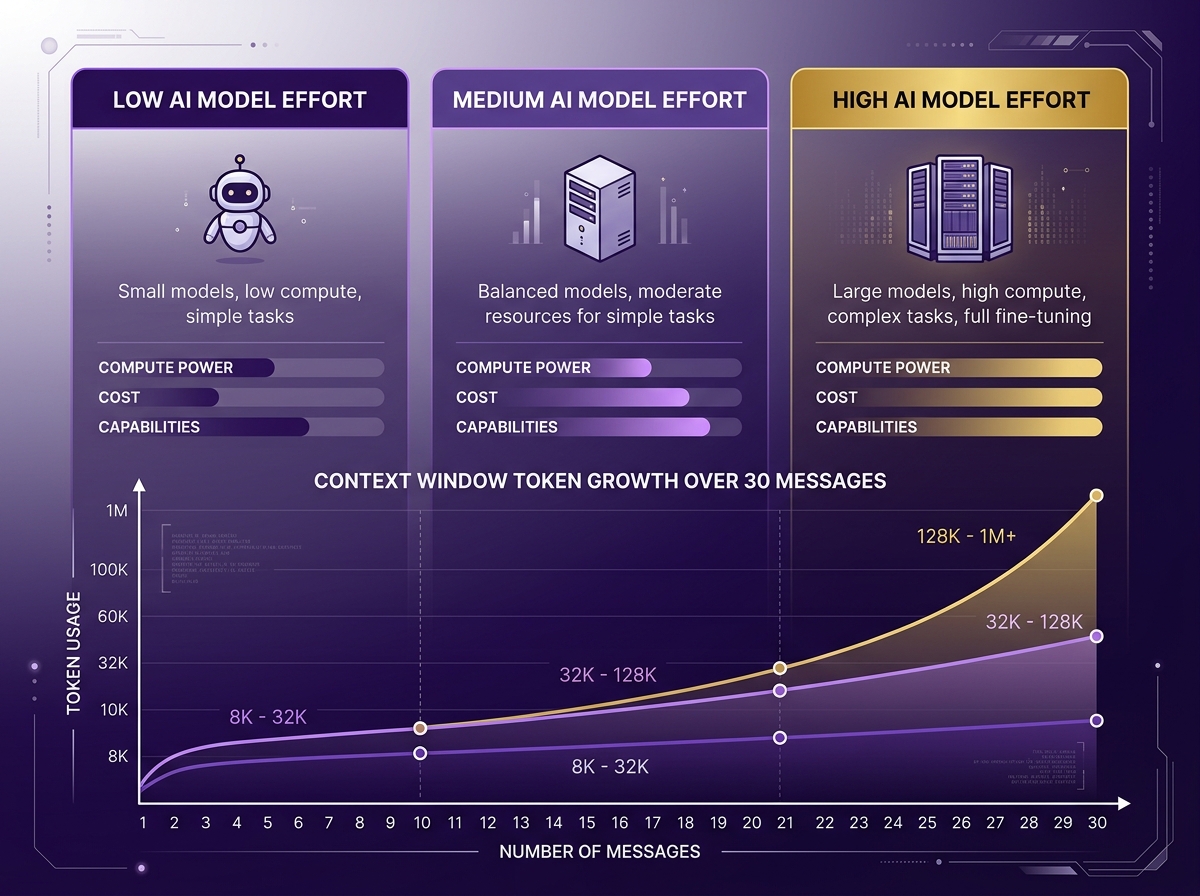
A common misconception is that AI engines only charge for the new prompt you type. In reality, on every turn of a conversation, the engine must re-load and re-read the entire conversation history, the system prompt, and all active skills or connected tool definitions. If you are 30 messages deep into a chat session, a single 10-word follow-up prompt can easily trigger the reading of 15,000 background tokens.
This compounding effect means that a bloated chat session not only drains your financial limits faster, but also degrades the quality of the model’s output. Language models pay the most attention to the beginning and the end of their context windows, meaning a bloated context window will lead to the model “forgetting” instructions in the middle.
Matching Model Effort to the Task
In 2026, leading model architectures allow developers to configure the “effort” or reasoning depth of the model. Higher effort levels produce superior output for complex coding or deep research but consume significantly more tokens. Marketers must learn to pair tasks with the appropriate model effort, as detailed in the comparison table below:
| Task Complexity | Recommended Effort | Cost Profile | Example Use Cases |
|---|---|---|---|
| Low Complexity | Low | Cheapest | Formatting files, renaming, sorting keyword lists. |
| Moderate Complexity | Medium | Balanced | Drafting standard social media posts, email subjects. |
| High Complexity | High (Default) | Standard | Writing 2,000-word blog posts, generating SEO metadata. |
| Deep Reasoning | XHigh / Max | Premium | Competitor audit, complex coding, orchestrator building. |
Four Essential Moves for Token Hygiene
To reduce your token consumption by up to 50% without compromising the quality of your output, implement these four rules:
1. Disconnect Unused Tools and MCP Servers
Every active Model Context Protocol (MCP) server or tool configuration loads its function definitions into the context window on every turn. Disconnect any server or tool that is not strictly necessary for the active task to save thousands of tokens per message.
2. Keep Instruction Rules Lean
Avoid placing entire code files or long reference guides directly into your agent’s primary rulebook (like `GEMINI.md`). Instead, use it as an index file containing short summaries that reference external folders (like `skills/`) by name, loading them only when needed.
3. Use Plan Mode First
For multi-step executions, have the model map out its approach in an implementation plan file first. Obtaining approval on a plan prevents the model from proceeding down the wrong path, saving hours of execution and tens of thousands of tokens.
4. Leverage the /clear and /compact Commands
When switching to a new task, always clear the chat session using the `/clear` command. If you are mid-session and see the context window filling up, use the `/compact` command to summarize the conversation details and free up space.
Frequently Asked Questions (FAQ)
What is a token in generative AI?
A token is a small chunk of text that an AI model processes. It is the basic unit of billing for API usage. Approximately four characters of English text equal one token, or three-quarters of a word.
Why do AI chats get slower and more expensive over time?
This happens because the AI model must read the entire chat history on every new message you send. As the history grows, the input token count compounds, increasing processing time and billing cost.
How does the /compact command help?
The `/compact` command instructs the agent to summarize the active conversation details, discard the verbose message history, and carry forward only the essential instructions, reducing context window usage.